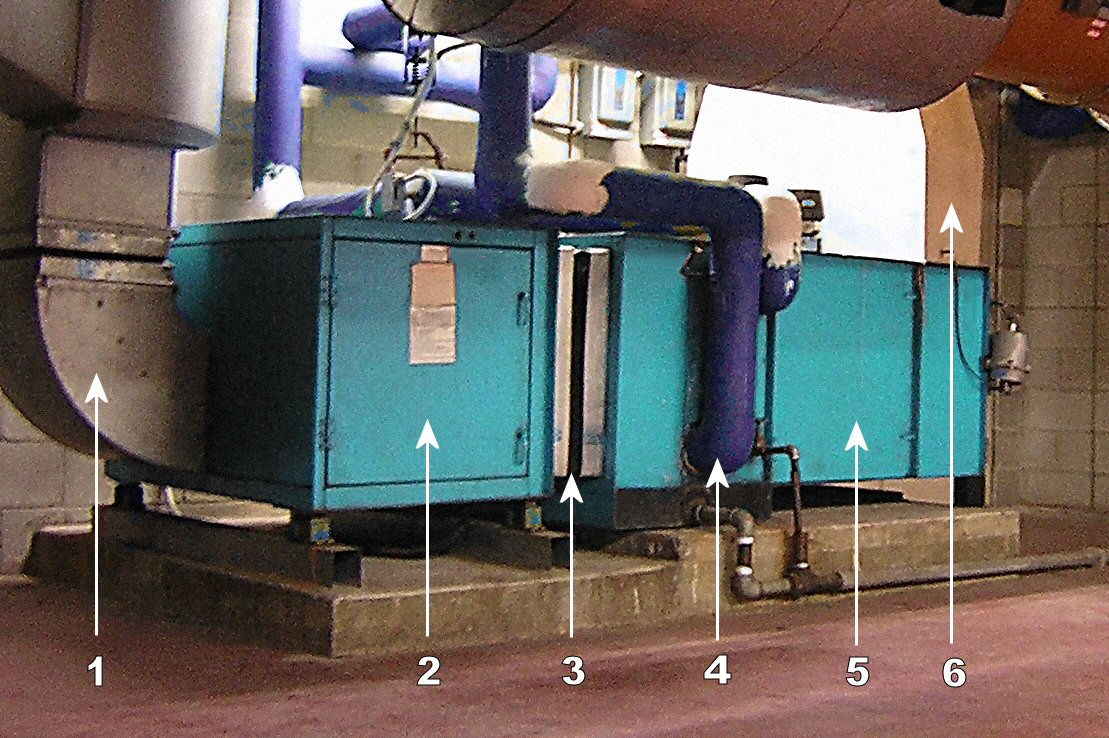
Air filtration is the primary means by which mechanical ventilation systems remove particulate matter — including PM10, PM2.5, and PM1 fractions — from the outdoor air supplied to a building's occupied spaces. The effectiveness of the filter and its correct maintenance determine whether the ventilation system improves indoor air quality or merely moves uncleaned outdoor air through the building at controlled flow rates.
Two parallel frameworks govern air filtration and indoor air quality in Czech buildings: the ISO 16890 filter classification standard, which replaced the older EN 779 standard in 2018, and Czech technical norms (ČSN) that define maximum acceptable concentrations of key pollutants in indoor air.
EN ISO 16890: Filter Classification
ISO 16890 classifies air filters by their efficiency in removing particles of specific aerodynamic diameters, tested after the filter has been electrostatically discharged (to prevent artificially inflated initial efficiency readings). The resulting classification uses three particle size categories:
- ePM1 — particles ≤ 1 µm (includes fine combustion particles, tobacco smoke, and many biological aerosols)
- ePM2.5 — particles ≤ 2.5 µm (includes the PM2.5 fraction associated with cardiopulmonary health effects)
- ePM10 — particles ≤ 10 µm (coarse dust, pollen, fungal spores)
A filter is classified in the finest particle category for which its efficiency equals or exceeds 50%. The classification is then appended with the efficiency figure rounded to the nearest 5%: for example, an ePM1 55% filter achieves at least 55% average efficiency against PM1 particles.
Minimum filter requirements for Czech buildings
ČSN EN 16798-3 (residential buildings) and ČSN EN 16798-5-1 (non-residential) reference minimum filter class requirements based on outdoor air quality category and the required indoor air quality category. For Czech cities, where outdoor air is generally classified ODA2 (slightly polluted with high particle concentrations) to ODA3 (highly polluted) in industrial and transport corridors, the typical minimum for supply air filters in MVHR systems targeting Category II indoor air quality is:
- Pre-filter at the outdoor air intake: minimum ePM10 50% (equivalent to former G4)
- Fine filter before supply to occupied rooms: minimum ePM1 55% (equivalent to former F7)
Buildings within 100 m of a major road or in Prague 1–5 districts (measured average PM2.5 above 15 µg/m³ in 2023–2024 per Czech Hydrometeorological Institute data) benefit from ePM1 70% or higher fine filtration to maintain indoor PM2.5 levels well below the WHO 2021 guideline of 15 µg/m³ as a 24-hour mean.
HEPA Filters in Building Ventilation
HEPA (High Efficiency Particulate Air) filters, classified H13 and H14 under EN 1822, achieve ≥ 99.95% and ≥ 99.995% efficiency respectively against particles of the most penetrating particle size (MPPS, typically 0.1–0.3 µm). These are not routinely used in standard residential MVHR systems because their high pressure drop (typically 150–250 Pa initial pressure drop) significantly increases fan energy consumption and accelerates filter loading.
HEPA filtration is appropriate in buildings housing immunocompromised occupants, in medical-grade facilities, or in locations with documented biological contamination risk — and in portable air purifiers for individual rooms where central MVHR filtration is insufficient.
Indoor CO₂ Concentration
Carbon dioxide (CO₂) is not a toxin at the concentrations found in occupied buildings, but it functions as a reliable proxy for overall indoor air staleness — if CO₂ is elevated, other occupant-generated pollutants (water vapour, volatile organic compounds, airborne particulates) are likely elevated proportionally.
ČSN EN 16798-1 uses CO₂ concentration above ambient outdoor levels to define indoor air quality categories:
- Category I: < 550 ppm above outdoor (approximately 970 ppm total with 420 ppm outdoor background). High-sensitivity applications — nurseries, allergy clinics.
- Category II: < 800 ppm above outdoor (approximately 1,220 ppm total). Standard residential and office design target.
- Category III: < 1,350 ppm above outdoor. Minimum acceptable; typical of existing buildings not yet retrofitted.
- Category IV: ≥ 1,350 ppm above outdoor. Poor indoor air quality; remediation required.
Continuous CO₂ monitoring in occupied spaces, using NDIR (non-dispersive infrared) sensors with periodic calibration, is the most practical way to verify that a ventilation system is delivering sufficient fresh air rates in real operating conditions. Sensors are available at 1,500–4,000 CZK per unit (2025 market pricing) and integrate readily with building automation systems or standalone alarm units.
Volatile Organic Compounds (VOCs)
VOCs — a broad category including formaldehyde, benzene, toluene, limonene, and many others — are emitted by building materials, furniture, cleaning products, and cooking. Czech guidance on VOC limits in indoor air references the WHO Indoor Air Quality Guidelines (2010) as the primary technical basis, complemented by Vyhláška č. 268/2009 Sb. (on technical requirements for buildings), which references maximum TVOC (total volatile organic compound) concentrations of 300 µg/m³ as a long-term guidance value for residential spaces.
MVHR systems contribute to VOC dilution in proportion to their fresh air supply rate, but do not chemically remove VOCs from supply air. Activated carbon (AC) filters can be added to supply-side filter stages to adsorb gaseous pollutants including odours and VOCs with boiling points above approximately 60°C. AC filters require replacement every 6–12 months, as their adsorption capacity is finite and desorption can occur when the adsorbed load saturates.
Relative Humidity and Mould Risk
ČSN 73 0540-4 and the commentary to ČSN EN 16798-1 both cite a relative humidity range of 30–60% as the target for occupied residential spaces. Below 30% RH, respiratory mucosa dries, increasing susceptibility to airborne infection. Above 65% RH sustained for more than 48 hours, mould growth risk increases on cold surfaces (external walls, window reveals, thermal bridges).
Balanced MVHR with a counterflow plate exchanger removes moisture from the building in proportion to supply airflow — typically reducing indoor RH by 5–15 percentage points relative to an exhaust-only system in winter, which helps control mould risk in airtight construction. Enthalpy (hygroscopic) heat exchangers partially retain moisture in the supply air, which can be advantageous when indoor RH would otherwise fall below comfort thresholds in cold, dry conditions.
Radon
The Czech Republic has one of the highest average indoor radon concentrations in Europe, due to radon-emitting granite and uranium-bearing bedrock geology across Bohemia and parts of Moravia. The Czech Atomic Energy Authority (SÚJB) sets a reference level of 300 Bq/m³ for indoor radon in existing buildings and 100 Bq/m³ as the design target for new construction (in line with Directive 2013/59/Euratom).
Mechanical ventilation contributes to radon dilution by replacing radon-laden indoor air with outdoor air. At a ventilation rate of 0.5 h⁻¹ and steady-state radon entry rate, the indoor concentration is approximately halved relative to a completely unventilated space. Buildings in designated radon risk zones require additionally a radon-barrier membrane beneath the ground floor slab — ventilation alone is not sufficient as the primary radon mitigation measure.
Filter Maintenance and IAQ Degradation
The most common cause of poor indoor air quality in buildings with installed MVHR is filter neglect. A clogged filter increases system pressure drop, reducing actual supply airflow below the designed rate. At 50% above the clean filter's rated pressure drop, airflow through a constant-pressure-fan system may fall to 70% of design — insufficient for the occupancy pattern the system was sized for.
Practical indicators of filter overloading include: reduced supply air velocity at diffusers (measurable with a vane anemometer), increased fan noise (the fan works harder at reduced airflow), and elevated CO₂ readings during normal occupancy. Any of these should trigger a filter inspection and, if confirmed, replacement before the next scheduled interval.
References
- Czech Hydrometeorological Institute (CHMI) — air quality data
- National Radiation Protection Institute (SURO) — radon mapping
- EN ISO 16890-1: Air filters for general ventilation — Part 1: Technical specifications, requirements, and classification system
- EN 1822: High efficiency air filters (EPA, HEPA and ULPA)
- WHO Indoor Air Quality Guidelines: Dampness and Mould (2009)
- Vyhláška č. 268/2009 Sb. — on technical requirements for buildings (Czech Republic)
- ČSN EN 16798-1: Energy performance of buildings — ventilation for non-residential buildings